Red Level
Lesson Eighteen
Gerund
Gerunds, like infinitives, look like verbs, but they actually function as nouns. Consider the following sentences:
- I like going to the beach. (“like” is the verb; “going” is the gerund.)
- Playing volleyball at the beach is fun. (“Playing” is the gerund and functions as the subject.)
- I like eating cold pizza. (“like” is the verb; “eating” is the gerund.)
Gerunds are often confused with verbs. Because gerunds take an “ing” ending, some students mistake them for verbs in the continuous form. If you don’t see the verb “be” in front of a word with an “ing” ending, it’s probably a gerund. For example, which sentence has a gerund?:
- He thinks that learning English is important for his career.
- This morning, they’re meeting their friends at the airport.
If you said the first sentence, you’re correct! The second sentence is in the present continuous tense.
The second video at the bottom of this page can provide you with more help in understanding the difference between gerunds and verbs that appear in continuous tenses.
I like listening to the radio. (Gerunds are often used after the verb “like.”) |  |
| He likes eating popcorn when he goes to see a movie. |  |
Playing in the snow is one of life’s greatest pleasures. (Gerunds commonly appear at the beginning of a sentence. They are easier to use than infinitives in this position.) |  |
Drinking coffee in the morning is one of my favorite things to do. | 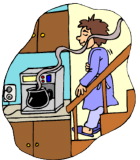 |
He finds playing the guitar to be relaxing. |  |
Now do you understand the differences between
gerunds and infinitives?
If not, go back to Lesson Seventeen,
or try this quiz.
One more thing: Don’t confuse
gerunds with the present continuous tense!
Next: Lesson Nineteen
possessive pronouns